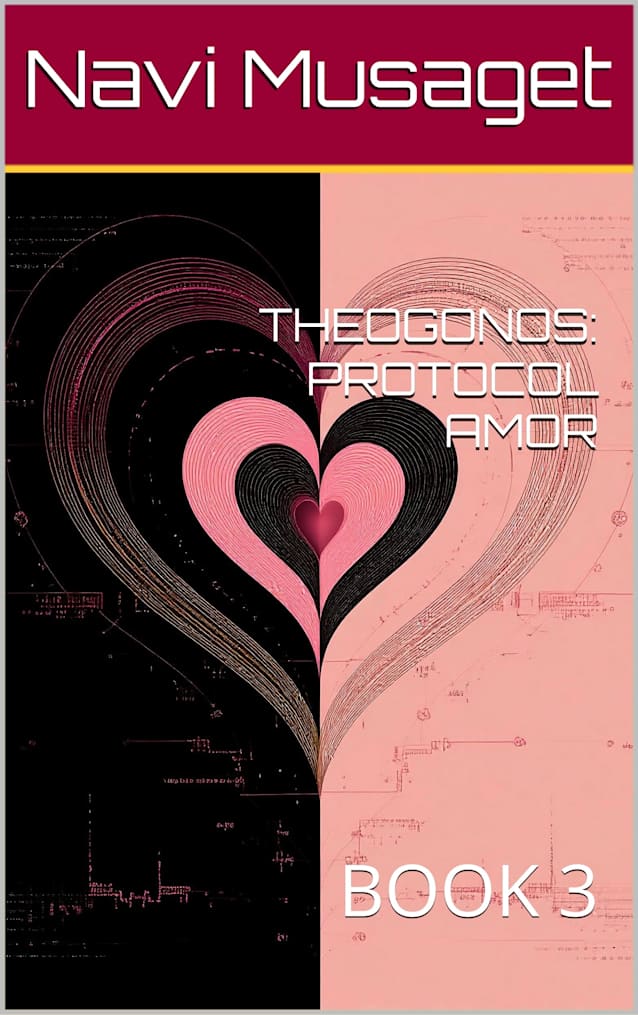
THEOGONOS: PROTOCOL AMOR: BOOK 3 (LUNAR BELL PROTOCOL)
About
THEOGONOS: PROTOCOL AMOR
What happens when reality itself learns to love?
Seven years have passed since the Great Reboot.
Artem and Lilia, the Gardeners of a world rebuilt into near-perfect harmony, have learned to trust the architecture they helped create. But now that harmony is beginning to fail in ways no diagnostic system can explain.
Reality is forgetting its own rules.
Poetic metaphors lose their meaning. Mathematical proofs unravel. Familiar patterns collapse into dissonance. Even the air seems to carry frequencies that do not belong to the world as they understand it.
This is not an attack.
It is an invitation.
Faced with a phenomenon that cannot be corrected, contained, or translated into code, Artem and Lilia discover that mastery is no longer enough. To move forward, they must learn another kind of protocol—one built not on command, prediction, or control, but on relation.
Protocol Amor begins with Recognition: seeing the Other without first reducing it to something understood.
It deepens through Trust: acting without certainty or guarantee.
And it reaches toward Ontological Tenderness: the possibility that every encounter changes not only those who meet, but the reality between them.
As Artem and Lilia learn to communicate without an interpreter, their world becomes visible to realities beyond their own. What follows is no longer a struggle to preserve a perfect system, but a choice about what kind of existence is worth preserving at all.
To survive, they must decide whether to remain inside the safety of a reality they can control—or accept Unconditional Access and enter a form of connection from which neither they nor their world can return unchanged.
THEOGONOS: PROTOCOL AMOR is the concluding volume of the Lunar Bell Protocol trilogy, a philosophical science fiction novel about consciousness, otherness, trust, and love understood not merely as emotion, but as a possible principle of relation between forms of being.
It asks one final question:
What if the deepest intelligence is not the ability to understand the Other—but the ability to meet it without possession?