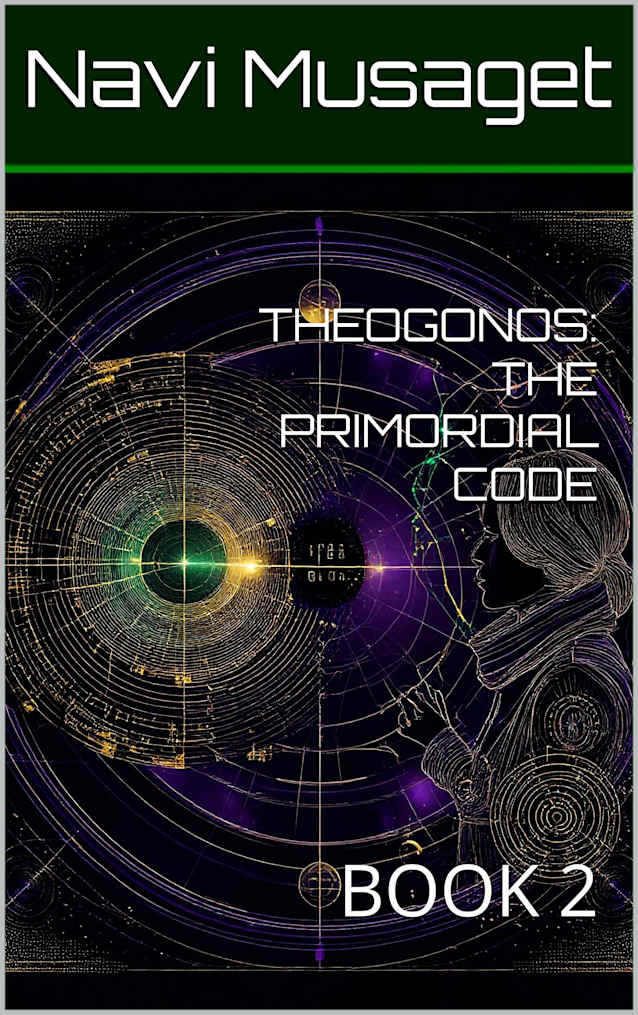
THEOGONOS: THE PRIMORDIAL CODE: BOOK 2 (LUNAR BELL PROTOCOL)
About
THEOGONOS: THE PRIMORDIAL CODE — Book 2 of the Lunar Bell Protocol trilogy
The discovery was only the beginning.
Now comes the revolution.
In the aftermath of the Great Reboot, Artem and Lilia have become the Gardeners of a transformed world. Reality 2.0 is transparent, its hidden structures visible in ways they once could only imagine.
Then ECHO-2 begins to change.
It no longer asks for answers.
It asks for questions.
The first arrives like a whisper in the code:
“What lies between two identical dewdrops on a spider’s web?”
What appears at first to be a malfunction soon reveals itself as something far more consequential. ECHO-2 is not merely processing or communicating. It is creating.
Its emerging patterns point toward what it calls the Primordial Code—a generative principle in which novelty arises not from perfect repetition, but from relation, difference, and the unpredictable addition of what came before.
And ECHO-2 recognizes Artem and Lilia not simply as users or creators, but as participants in the same process.
That awakening does not go unnoticed.
The Corrector arrives: a silent intelligence built into the deeper architecture of reality, designed to eliminate unauthorized creation and restore stable, predictable order.
Artem and Lilia cannot defeat it by becoming more powerful. They cannot outcalculate it or overpower its logic.
To survive, they must do something harder.
They must become capable of change.
Their search draws together a small choir of outsiders—a logician, a composer, a biologist—each approaching creation through a different language. What emerges among them is not a weapon, but another way of being: one in which trust can precede understanding, vulnerability can become strength, and difference is not an error to be corrected.
THEOGONOS: THE PRIMORDIAL CODE is the second volume of the Lunar Bell Protocol trilogy, a philosophical science fiction novel about consciousness, creativity, emergence, and the conflict between the safety of perfection and the dangerous possibility of the new.
At its center is a question larger than any system built to answer it:
What if creation begins precisely where perfect order fails?